
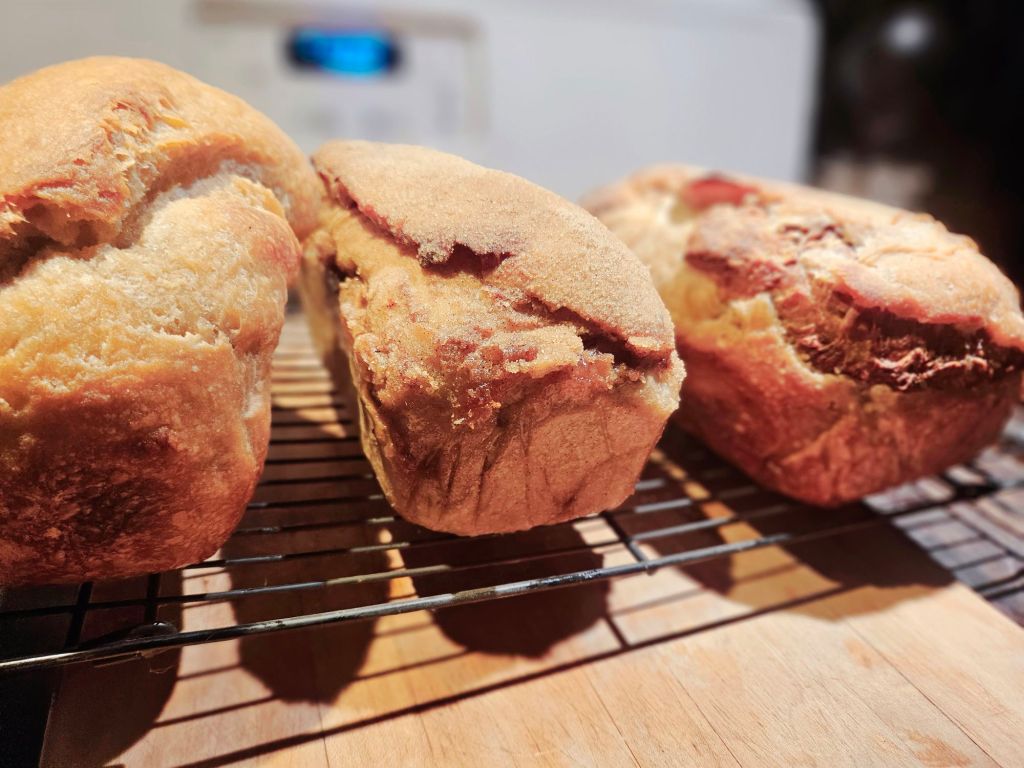
This is a great, no-fuss recipe for beginners!
,
Ingredients:
- 200 g. fed starter
- 400 g. Water – room temperature
- 650 g. Flour, your choice
- 15 g. Salt
Directions:
• Mix water and flour
• Allow to rest to for 30 min (called autolyse)
• Add starter
• Mix well
• Allow to rest for 30 min
• Add salt
• Mix well
• Allow to rest, covered, on counter, 1 hour
Shape and allow to bulk ferment
for 3-12 hours on the counter or place in refrigerator. *
(Bulk fermenting just means the whole bulk of it is hanging out together for a little bit longer.)
*For more “sour” taste,
allow dough to cold proof
in refrigerator for 12-48 hours, covered.
Bring to room temperature prior to baking and then shape into desired shape. This is a counter ferment because our dough is no longer one bulk, but rather individual loaves on the counter, awaiting baking. So, when you see these terms in future recipes, you will know the difference.
Once loaves pass the poke test with appropriate results, please see below, then you are ready to bake!
Bake at 400° for 40-50 min
in bread loaf or on cookie sheet.
Parchment paper helps
avoid burning on the bottom.
If your bottom is getting toasty,
feel free to remove from pan
and open bake the loaf straight on the rack.
Bread is done when
internal temperature reaches 205°.
Crust tip:
☆For a crackled, tender flakey crust,
bake with a pan of water in the oven.
☆ For a firm, crunchy, harder crust,
eliminate moisture or use a Dutch Oven and bake at 450°
for 20-30 minutes and then lower to 425° for 20-30 minutes.
Scoring Tip:
Some loaves don’t score well for a variety of reasons.
If your loaf is not scoring well,
then your bread may need more time to rise.
However, I have also found it helpful to bake a loaf for 6 minutes
and then score it and then allow it to continue baking.
☆This is not the recipe I use for the loaves I sell, however it is a recipe I created for sourdough in a pinch as it
can be made and baked in one day.☆

This was the first recipe that I had general success with when I first began on my journey.
You learn to recognize when your bread is done rising and when it’s baked to the perfect point, remember don’t stress out, just learn to trust the process.
Proof test:
Dough gently returns to shape when poked:
Bread is done rising when you poke it gently and it slowly rises back towards you.
Dough is hard, flat, doesn’t rise when poked:
If it doesn’t rise at all when poked then allow to proof/rise for longer. Sometimes in this situation it is beneficial to put your covered bowl in the oven with a pan of steaming water. Warn others that the bread is in there to avoid prematurely baked break…and chaos.
Dough is light, airy, balloon like and falls when poked:
If the dough falls where poked and doesn’t return to shape, then it has proofed for too long and can be used for alternative breads such as focaccia. My theory is always, “Bake it anyway” as we are often surprised by what results. If it is a disaster then we aren’t out anything because we were going to throw it away anyways. Even if you are convinced it’s ruined, within reason, try baking it anyway and see what turns out!
 Redbrickranch.net